Very well done complex information package about the trees around us. I appreciate all the effort that went into making this. It’s wonderful.
Eatweeds Press
The Complete Tree and Shrub Notebook Collection
The Complete Tree and Shrub Notebook Collection
Regular price
£24.95 GBP
Regular price
Sale price
£24.95 GBP
Taxes included.
Shipping calculated at checkout (does not apply to digital products)
Quantity
Couldn't load pickup availability
Fifteen trees. Their forgotten stories. Folklore, food and medicine, gathered in one place.
Most of us can name twenty brands without thinking.
Some of us can't name the tree outside our own front door.
Let alone what it was once used for.
And here's the truth of it:
That wasn't always the case.
For most of human history, every hedge, every roadside oak, every scrubby patch of woodland carried a name, a use, a warning, a story.
People knew which berries fed you, and which ones could kill you.
Which bark eased a fever.
Which tree you simply didn't cut down without asking first.
That relationship took centuries to build.
It's taken less than three generations to nearly lose it.
What this is
This is the Complete Tree and Shrub Notebook Collection.
Fifteen notebooks. One for each of Britain's most significant trees and shrubs.
Ash. Beech. Crab Apple. Elder. Hawthorn. Hazel. Lime. Oak. Pine. Rosehip. Rowan. Sea Buckthorn. Sloe. Strawberry Tree. Wild Service Tree.
Written by Robin Harford (full bio below), an ethnobotanical researcher who has spent more than two decades trying to recover exactly this kind of knowledge before it disappears for good.
771 pages, drawn from old herbals, regional folklore collections, and plant-lore studies most people have never heard of.
What you'll discover
- The old beliefs and rituals once wrapped around each tree, and what was really behind them
- Which parts were eaten, and how — traditional recipes alongside contemporary food uses
- Traditional and modern medicinal uses, with the safety notes you need to know
- A proper botanical profile for each tree, with colour photographs, so you can identify it with confidence
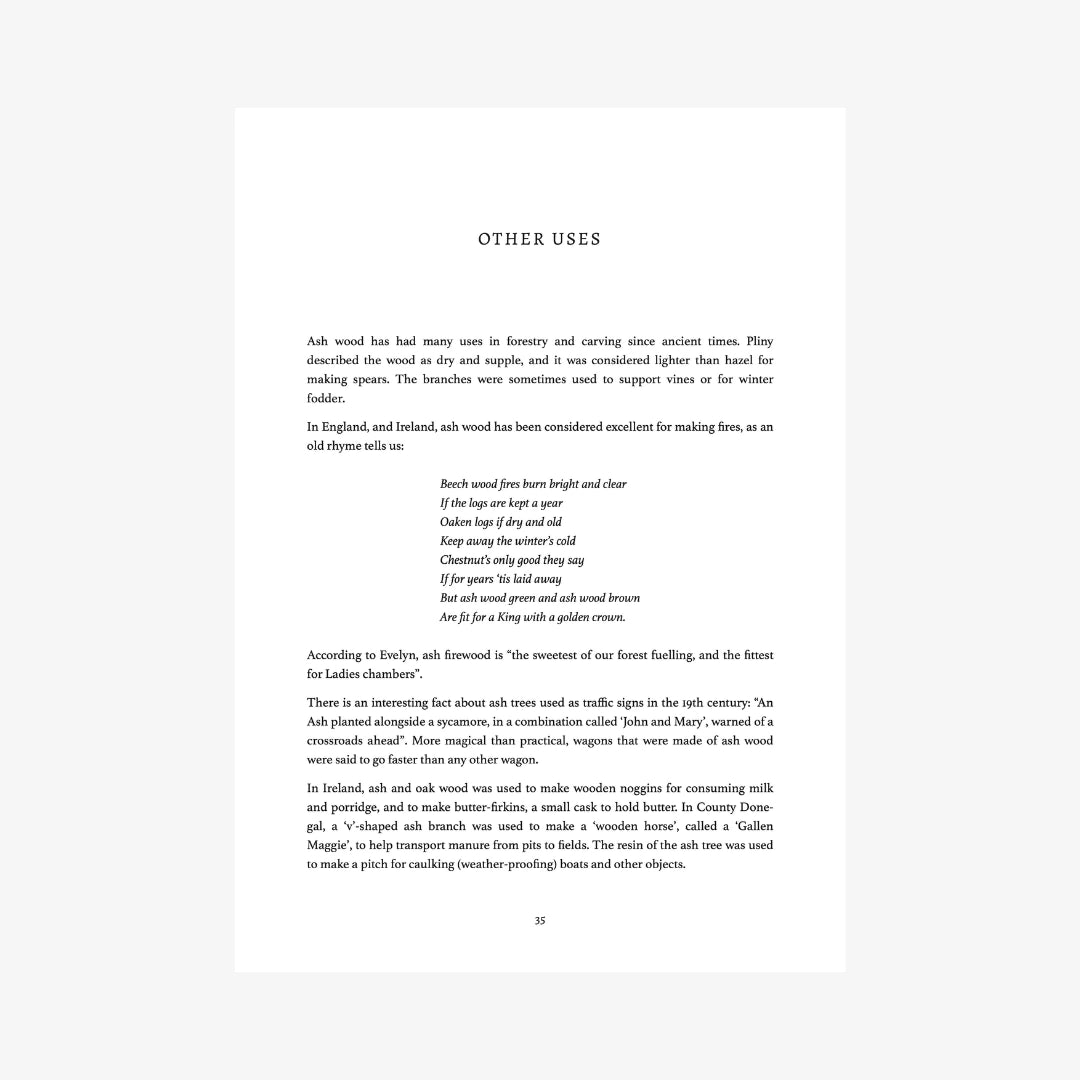
- The quieter uses — for dye, for timber, for craft
This is the difference between walking past a tree and knowing it. Between a landscape that's just scenery, and one that means something again.
Why this doesn't exist anywhere else
Look for a book that does what this does, and you won't find one.
Most books pick a single angle. A foraging guide sticks to identification and food. A herbal sticks to medicine. Folklore gets its own separate shelf entirely.
This collection doesn't work that way.
It keeps the folklore, the food and the medicine of each tree together in one notebook, because that's how the knowledge actually lived. Nobody who once relied on a hawthorn hedge separated the story from the cure — it was a single body of knowledge, passed down whole.
As far as I know, nothing else on the market covers these fifteen trees at this depth, in one place.
Why this is a digital download
This is a digital download. Available immediately.
At 771 pages, this collection runs closer to three ordinary books than one slim guide.
Printing something this size, to a standard that does the photography and the research justice, costs real money. In a cost-of-living crisis, that cost has to land somewhere — either in a much higher price, or in cut corners: thinner paper, smaller images, fewer pages.
For an independent author, neither of those sat right. So I went digital instead.
The price stays at £24.95 for all fifteen notebooks, well below what a printed edition this size would need to charge.
The photography stays large and sharp on a screen, sharper than cheap print could manage.
And you're reading it minutes after you order, rather than waiting on a delivery.
Who this is for
This collection IS for you if you want to:
- Recognise the trees around you, not just admire them
- Understand what earlier generations knew about them, and why
- Cook and forage from trees and shrubs with confidence, safely
- Pass this knowledge on to your children, or theirs
It's probably NOT for you if:
- You want a slim field guide and nothing more than identification
- You're set on a printed book for the shelf
- Folklore and history hold no interest for you
What people say
"Great quality images and fascinating histories of medicine, folklore, cookery." - Angela Goddard
"The scope, scholarship, references and wonderful photographs make these notebooks a brilliant resource and a source of constant pleasure. Thank you." - Lynne Friedli
"I've often heard people say they wish they could download Robin's brain and I think this is the closest we're going to get! The notebooks don't disappoint and are a real blessing." - Adam Reeve
"I have a small amount of knowledge and find your extensive writings absolutely absorbing." - Mandy Conway
The practical bits
- 15 notebooks covering Ash, Beech, Crab Apple, Elder, Hawthorn, Hazel, Lime, Oak, Pine, Rosehip, Rowan, Sea Buckthorn, Sloe, Strawberry Tree and Wild Service Tree
- 771 pages, A4 format
- Instant digital download — available the moment you order
- Readable on any device: desktop, tablet or phone
- One-time payment. No subscription
Price
£24.95
The relationship people once had with these trees didn't disappear because it stopped mattering.
It disappeared because nobody wrote it down in one place.
Now it is.
Your guide: Robin Harford

I am an ethnobotanical researcher and wild food educator and my work explores the relationship between people and plants.
I founded my foraging school in 2008. BBC Countryfile has named my courses among the finest in the UK.
I created Eatweeds, a wild food and ethnobotany resource recommended by Michelin-starred chef Richard Corrigan for inclusion in The Times' Top 50 Food and Drink Websites.
For more than two decades, I have travelled through Africa, India, South-East Asia, Europe and the United States, documenting the traditional uses of wild edible and medicinal plants.
My work has featured in BBC Good Food, The Guardian, The Times, The Independent and The Daily Telegraph.
I am also a member of the Society for Ethnobotany, the Botanical Society of Britain and Ireland, the Herb Society, and the Association of Foragers.
And the author of Edible and Medicinal Wild Plants of Britain and Ireland — over 65,000 copies sold.